UniDFlowMultimodal Reasoning and Generation via Unified Discrete Flow Matching

Onkar Susladkar♦, Tushar Prakash♣, Gayatri Deshmukh♣, Kiet A. Nguyen♦, Jiaxun Zhang♦, Adheesh Juvekar♦,
Tianshu Bao♠, Lin Chai♠, Sparsh Mittal♥, Inderjit S Dhillon★,♠, Ismini Lourentzou♦
♦PLAN Lab · University of Illinois Urbana-Champaign♣Independent Researcher♠Google♥IIT Roorkee★University of Texas at Austin

ICML 2026

TL;DR

We introduce UniDFlow, a discrete flow-matching model that unifies image understanding, generation, and reasoning-guided editing. Separate text and image LoRA adapters preserve specialized capabilities, while a lightweight Mixture-of-LoRA router composes them during diffusion. Multimodal Reference-based DPO (mRef-DPO) uses a visual reference and structured reflection traces to align edits with instructions, geometry, and physical transformations.

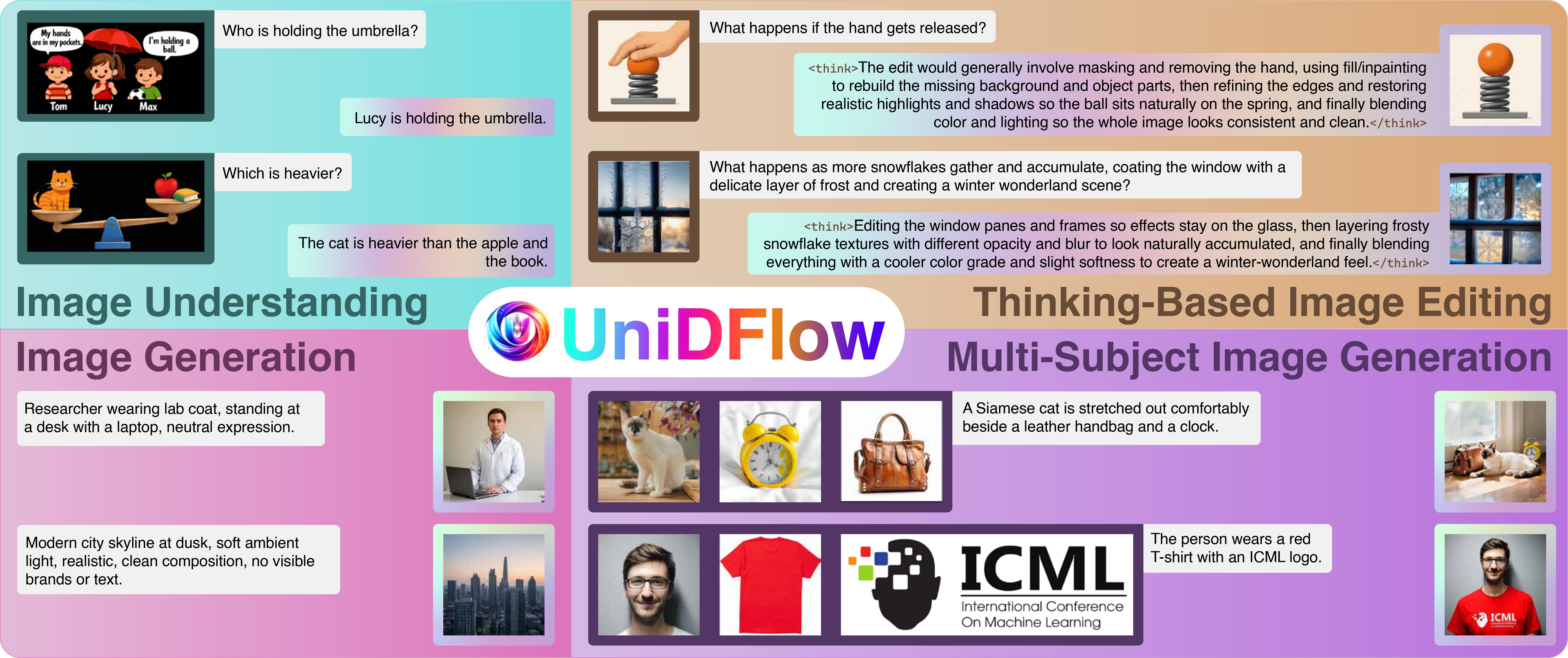
UniDFlow examples of image understanding, generation, and reasoning-guided editing.

One model supports visual understanding, text-to-image generation, and edits guided by reasoning.

Abstract

We propose UniDFlow, a unified discrete flow-matching framework for multimodal understanding, generation, and editing. UniDFlow decouples understanding and generation via task-specific low-rank adapters, avoiding objective interference and representation entanglement, while a novel reference-based multimodal preference alignment optimizes relative outcomes under identical conditioning, improving faithfulness and controllability without large-scale retraining. UniDFlow achieves SOTA performance across eight benchmarks and exhibits strong zero-shot generalization to tasks including inpainting, in-context image generation, reference-based editing, and compositional generation, despite no explicit task-specific training.

Contributions

  • UniDFlow unifies multimodal understanding, generation, and editing. We introduce a discrete flow-matching framework that bridges high-level visual reasoning and high-fidelity image synthesis within a unified model.
  • Task-specific adapters prevent interference between understanding and generation. Separate text and image LoRA adapters are trained while keeping the backbone frozen; KL regularization helps preserve linguistic ability. A lightweight Mixture-of-LoRA (MoRA) router dynamically composes the adapters during diffusion, combining their specialized capabilities.
  • Multimodal reference-based preference alignment improves faithful editing. mRef-DPO compares outcomes under identical conditioning against a frozen reference policy and a visual reference image. Structured reflection traces help the model reason through geometric, physical, and temporal transformations before generating the edited image.
  • Evaluation demonstrates broad performance and zero-shot generalization. UniDFlow achieves state-of-the-art performance across eight benchmarks and generalizes to inpainting, in-context image generation, reference-based editing, and compositional generation without explicit task-specific training for those tasks.

UniDFlow Method

UniDFlow learns understanding and generation through separate adapters on a frozen backbone, then combines them for reasoning-guided editing. The three training stages isolate the two objectives before aligning their joint behavior.

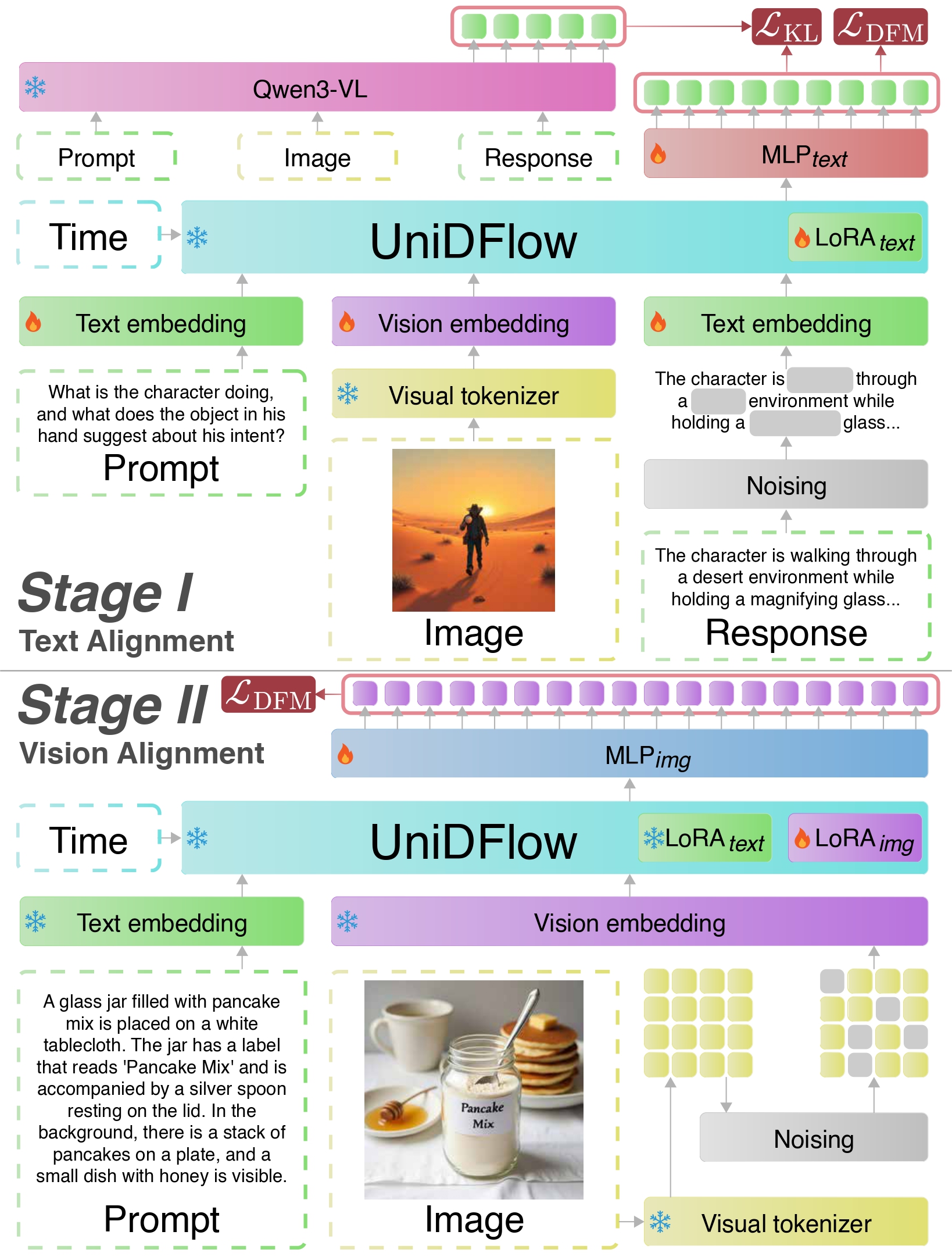
UniDFlow text and vision alignment: separate text and image LoRA adapters trained with discrete flow matching

Stage I · Text alignment

Text LoRA adapters learn to answer visual instructions using discrete flow matching. The backbone remains frozen, and KL regularization preserves linguistic ability while the model develops multimodal reasoning.

This stage establishes the understanding pathway that later guides image editing.
Stage II · Vision alignment

A separate image LoRA learns conditional generation in discrete visual-token space. The text adapters remain frozen, preserving their reasoning capability while image generation is trained.

Separating the adapters prevents the understanding and generation objectives from competing for the same parameters.

Stage III · Multimodal preference alignment

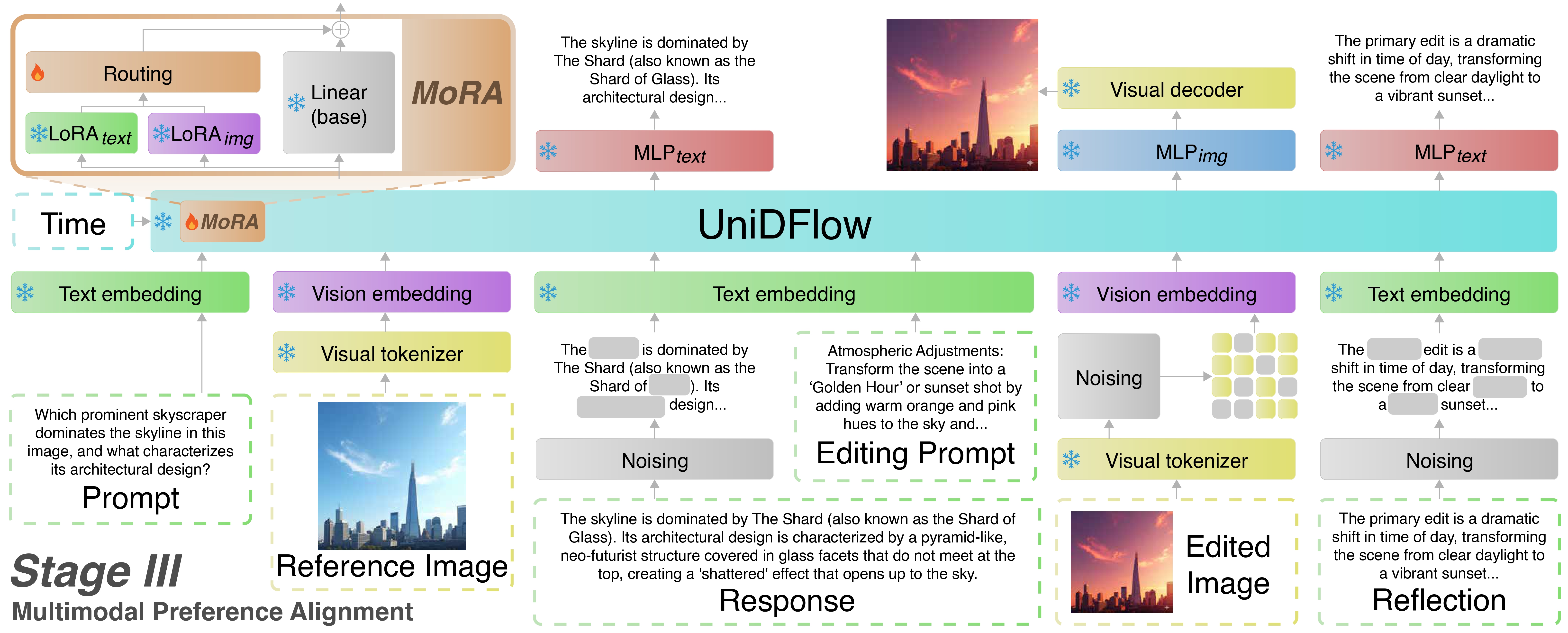
A lightweight Mixture-of-LoRA (MoRA) router dynamically composes the text and image adapters during diffusion. The model can combine visual reasoning with image synthesis at each step.

Multimodal Reference-based DPO (mRef-DPO) compares outcomes under identical conditioning against a frozen reference policy and a visual reference image. Structured reflection traces train the model to reason through geometric, physical, and temporal changes before producing the edit.

UniDFlow multimodal preference alignment with a Mixture-of-LoRA router, reference image, edited image, and reflection

Quantitative Results

Multimodal understanding

UniDFlow (4B) is evaluated on general multimodal question answering and visual reasoning. Compared with BAGEL, it achieves gains of +6.9% on MME-P and +7.0% on MME-S.

Multimodal understanding
Model Parameters MME-P MME-S MMBench MMMU MM-Vet MathVista MMVP
Qwen2.5-VL (Bai et al., 2025b) 3B — 2157 79.1 53.1 61.8 62.3 —
BLIP-3 (Xue et al., 2024) 4B — — 76.8 41.1 — 39.6 —
DeepSeek-VL2 (Wu et al., 2024b) 4B — — 51.1 60.0 62.8 — —
Qwen3-VL (Bai et al., 2025c) 4B — — 85.1 64.1 72.5 — —
VILA-U (Wu et al., 2024a) 7B 1336 — 66.6 32.2 27.7 — 22.0
Chameleon (Team, 2024a) 7B — — 35.7 28.4 8.3 — 0.0
Janus-Pro (Chen et al., 2025a) 7B 1567 — 79.2 41.0 50.0 — —
TokenFlow-XL (Geyer et al., 2023) 13B 1546 — 68.9 38.7 40.7 — —
BAGEL (Deng et al., 2025) 7B 1687 2388 85.0 55.3 67.2 73.1 69.3
OmniGen-v2 (Wu et al., 2025) 8B — — 53.1 61.5 — — —
EMMA (He et al., 2025) 4B — — 85.8 65.1 73.0 75.8 —
MammothModa-2 (Shen et al., 2025) 4B 1753 1998 86.6 71.23 79.4 81.8 77.5
Muddit (Shi et al., 2025) 4B 1700 1832 82.8 66.6 76.2 79.1 74.1
UniDFlow 4B 1803 2555 91.2 74.3 82.7 85.9 80.2

Text-to-image generation

UniDFlow (4B) outperforms same-scale unified competitors and larger generative models on text-to-image generation.

Text-to-image generation
Model Parameters GenEval DPGBench
DALL-E 3 (Betker et al., 2023) — 0.67 83.50
SD3-Medium (Esser et al., 2024) 2B 0.74 80.43
Qwen-Image(-RL) (et al., 2025) 7B+20B 0.91 88.32
TokenFlow-XL (Geyer et al., 2023) 14B 0.55 —
Janus-Pro-7B (Chen et al., 2025a) 7B 0.80 84.19
Bagel (Deng et al., 2025) 7B+7B 0.88 87.74
OmniGen2/V2 (Wu et al., 2025) 3B+4B 0.78 83.57
MammothModa-2 (Shen et al., 2025) 8B+3B+2B 0.87 87.20
EMMA (He et al., 2025) 4B 0.93 85.63
MUDDIT (Shi et al., 2025) 8B 0.90 86.37
UniDFlow 4B 0.95 91.19

Qualitative Results

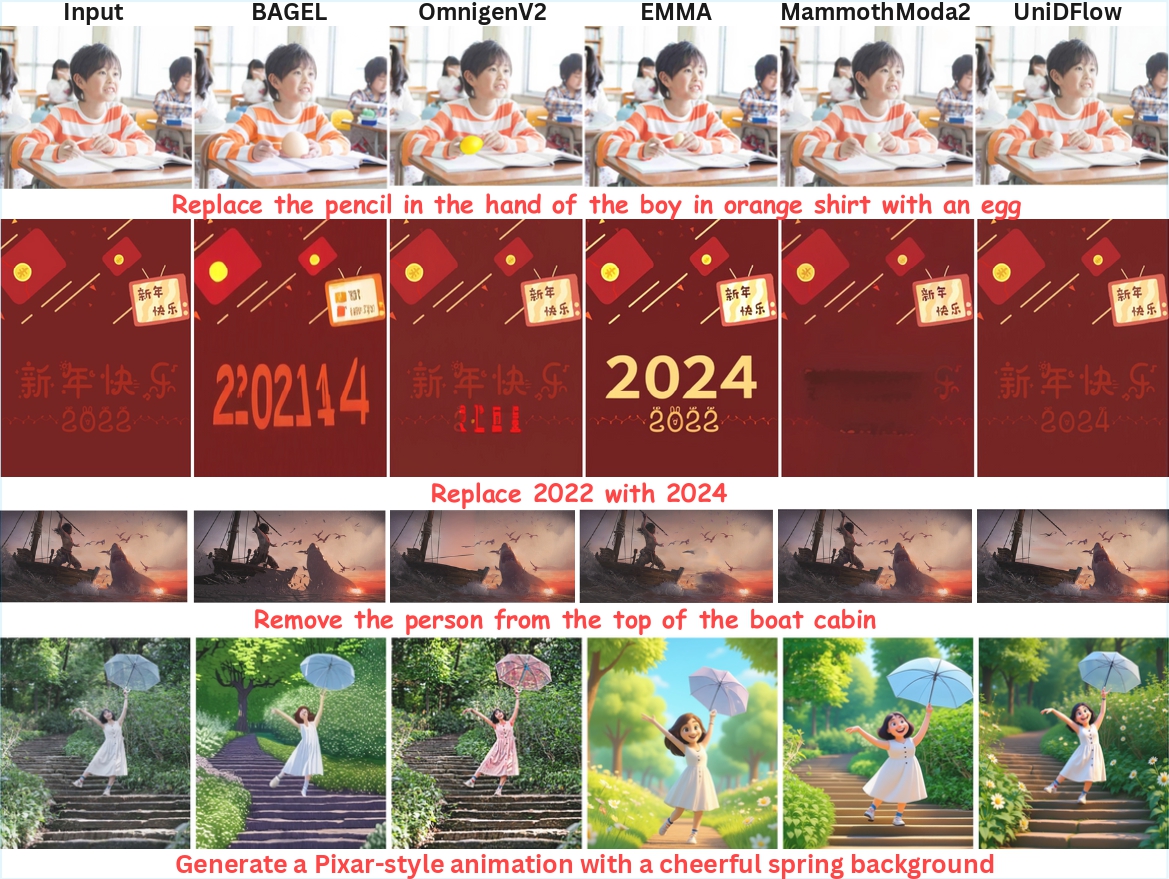
Qualitative comparison of compositional text-to-image generation and editing. Prompts require precise grounding of attributes and spatial relations (red text). UniDFlow consistently adheres to these constraints while maintaining realistic structure and visual fidelity, outperforming prior unified baselines.

Editing qualitative results. Editing qualitative results.

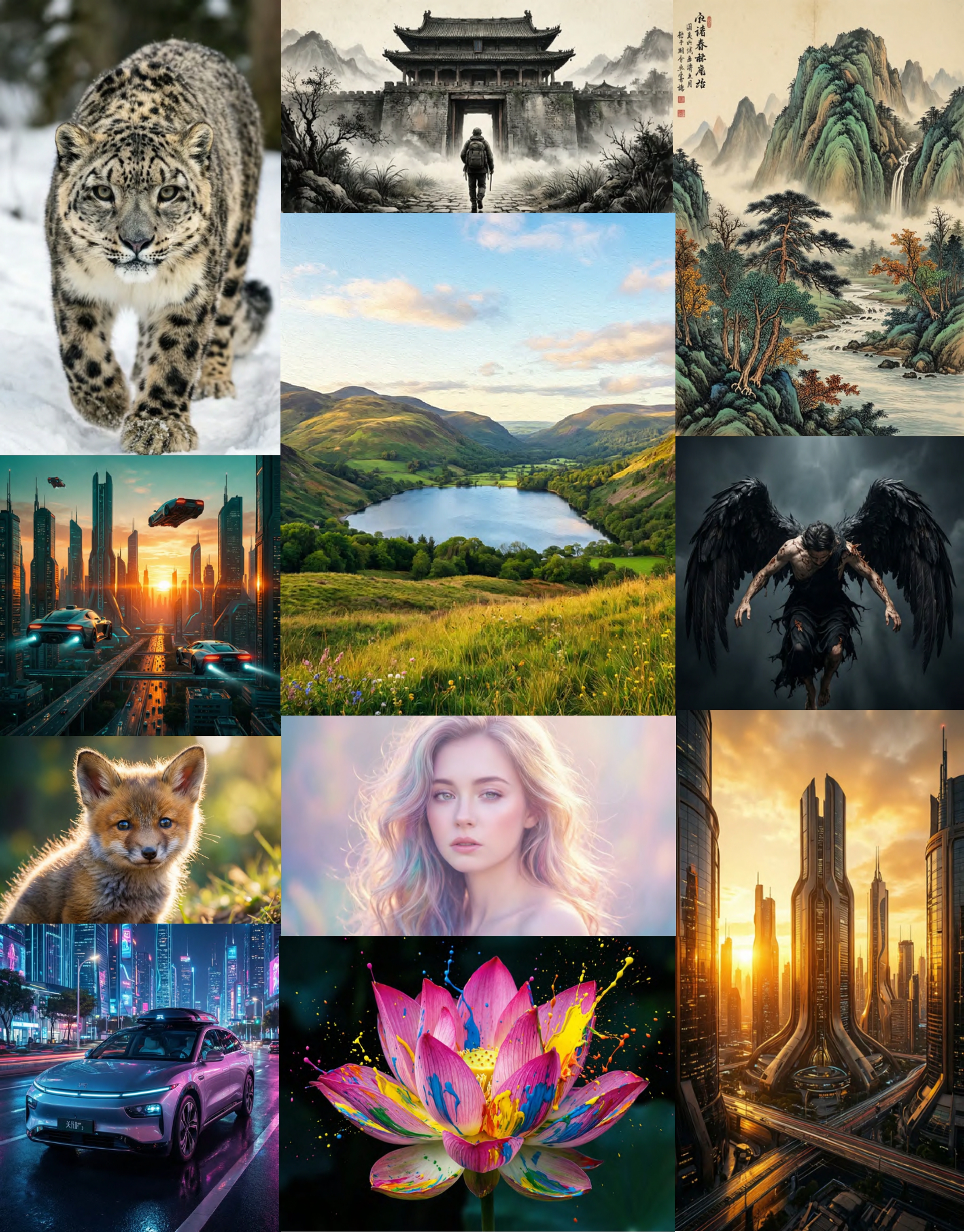
Qualitative Results: Text-to-Image Generation

Image generation with UniDFlow.

Generation qualitative results.

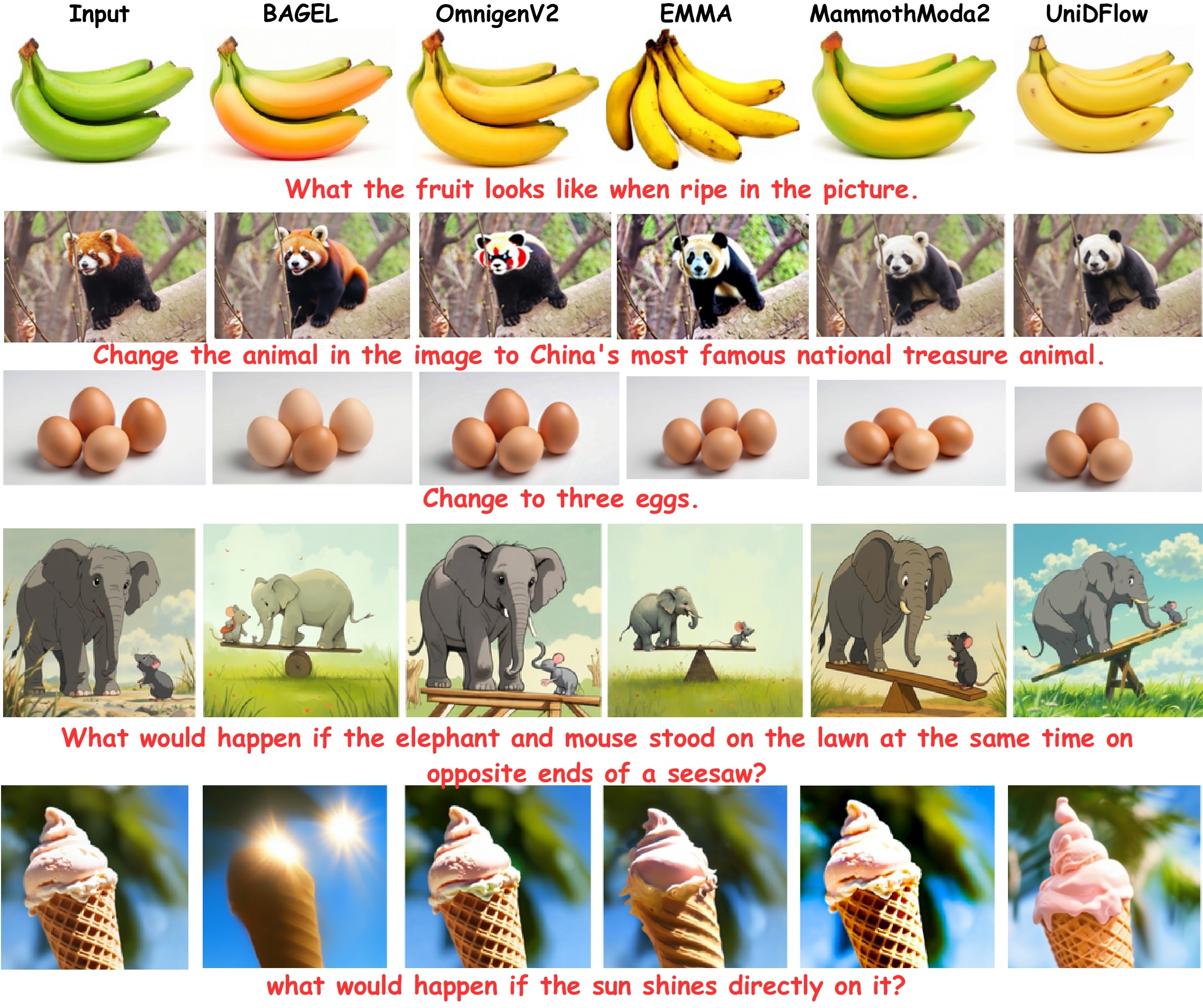
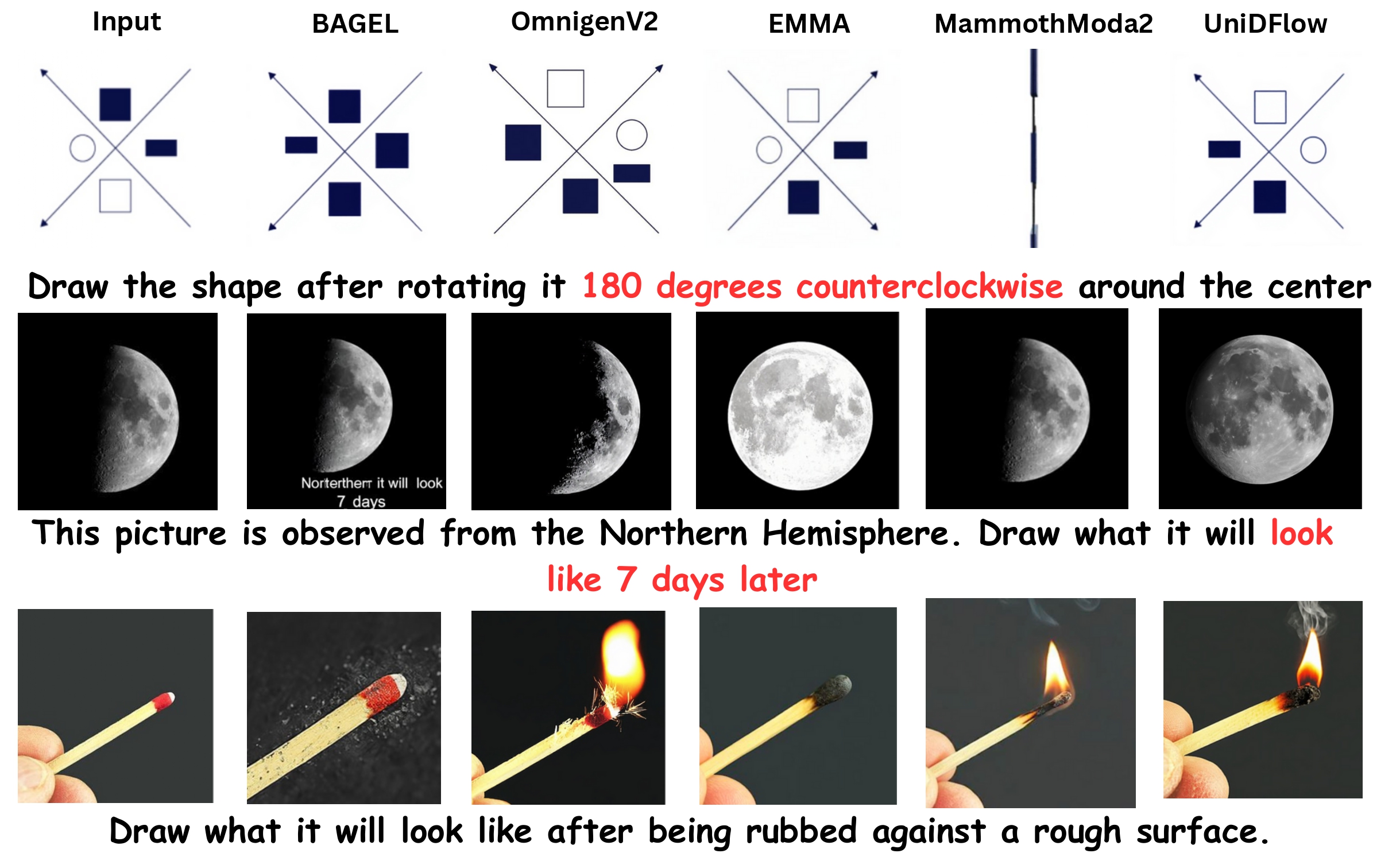
Qualitative Results: Reasoning-Based Image Editing

Reasoning-driven image editing, highlighting temporal, geometric, and physical transformations handled by UniDFlow.

Understanding qualitative results.

Qualitative Results: Image Understanding

Image-to-text generated results with UniDFlow.

Understanding qualitative results 2.

BibTeX

@inproceedings{susladkar2026best,
  title={Best of Both Worlds: Multimodal Reasoning and Generation via Unified Discrete Flow Matching},
  author={Susladkar, Onkar and Prakash, Tushar and Deshmukh, Gayatri and Nguyen, Kiet A. and Zhang, Jiaxun and Juvekar, Adheesh and Bao, Tianshu and Chai, Lin and Mittal, Sparsh and Dhillon, Inderjit S and Lourentzou, Ismini},
  booktitle={Proceedings of the International Conference on Machine Learning (ICML)},
  year={2026}
}